Echoes
“Places remember things differently than timelines do.”
2026
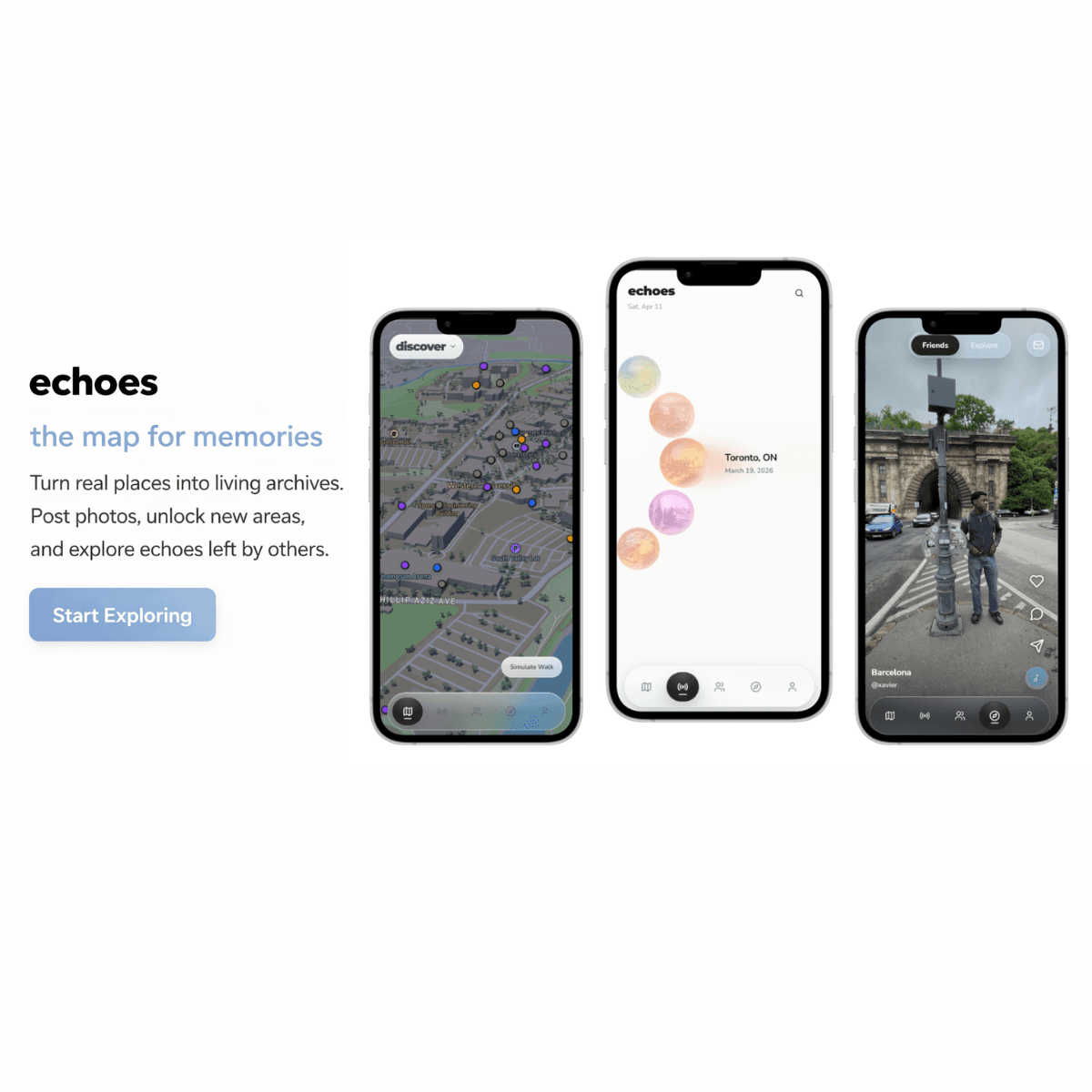
Echoes is a social map for digital memories. The project started from a simple feeling: some photos and moments are tied more strongly to places than to dates. A regular photo grid shows when something happened. Echoes explores what it would feel like to show where it happened.
The product turns memories into location-based fragments. Users can leave moments behind, revisit cities, and explore memories through a map-based interface.
The idea
Most social apps are built around feeds. Echoes is built around places.
A user posts a photo or memory fragment tied to a location. That moment becomes part of the map. Cities and memories are represented through orbs, fragments, and mementos, creating a product that feels more like discovery than scrolling.
Design prototype placeholder
Orb interaction / city memory placeholder
Design direction
The visual direction pulls from soft mid-2010s social-web warmth -- not by copying old apps, but by carrying forward the feeling of that era: playful, social, slightly dreamy, and more personal than the polished feeds people are used to now.
The interface uses soft motion, circular city orbs, map-based discovery, and warm visual details to make the app feel like a memory system instead of a utility.
What I worked on
I focused on product thinking, interaction design, and the core visual language. A major part of the work was figuring out how the app should feel when users move between locations, memories, and social discovery.
The goal was to avoid a generic map app. The map had to feel emotional. The memory objects had to feel collectible. The motion had to feel smooth, not mechanical.
Design prototype placeholder
Prototype flow placeholder
Key features
- Location-based memory fragments
- City orbs representing collections of memories
- Map-based discovery
- "Mine" and "Others" memory views
- Social exploration around places
- Nostalgic visual direction inspired by mid-2010s digital culture
What was hard
The hardest part was making the concept feel understandable without overexplaining it. Echoes is not just a map, and it is not just a photo app. It sits between both.
That meant the design had to teach the product naturally through motion, hierarchy, and repeated visual patterns.
What I learned
Echoes taught me how much product identity matters. A strong concept needs more than features. It needs a world, a rhythm, and a reason for people to care.